
Last Updated: November 1, 2026
Quick Summary
Mindful home decor for mental wellness means arranging your space to support calm, comfort and rest. Start with light, color and clutter, since these are the fastest ways to change how a room feels. Design supports wellbeing but does not replace care for stress or depression.
- Notice which rooms make you feel tense or rushed.
- Open curtains early and add a warm lamp for evenings.
- Use soft neutrals and one bold accent color, not five.
- Clear one zone at a time, such as kitchen counters or your desk.
- Track your mood for two weeks before and after one change.
Table of Contents
- How Home Design Affects Mental Health and Wellbeing
- Using Natural Light and Calming Colors in Mindful Home Decor
- Decluttering for Mental Health, Room by Room
- Biophilic Design at Home: Bringing Nature Indoors
- Creating a Relaxing Bedroom Decor Plan
- Calming Home Decor Ideas for Renters and Small Budgets
- Testing Whether Your Changes Help Your Mood
- Choosing Your First Mindful Change This Week
- Frequently Asked Questions
How Home Design Affects Mental Health and Wellbeing
Your home shapes how you feel every day, often without you noticing. Mindful home decor for mental wellness is about arranging your space so it supports calm, comfort and rest. (Source: a 2021 study on contrasting contours in living spaces and people's mood and behavior)
Researchers have begun testing this idea directly. A 2021 study on contrasting contours in living spaces and people's mood and behavior examined whether the visual shapes around us affect how we feel.
That gap matters. Design can help you feel calmer, but it is not a cure for stress or depression. Think of your home as one tool among many for daily wellbeing.
Here is what most people can do right away:
- Notice which rooms make you feel tense or rushed
- Pay attention to noise, clutter and harsh light
- Choose one room to improve first
Using Natural Light and Calming Colors in Mindful Home Decor
Light and color are the fastest ways to change how a room feels. Start with what you already have before you buy anything new.
Light tips:
- Open curtains early in the day to let in morning light
- Add a warm lamp for evenings instead of a bright overhead fixture
- Sheer curtains soften glare while keeping rooms bright
Color tips:
- Soft neutrals like warm white, sand and sage tend to feel restful
- Use one bold accent color, not five
- Test paint on a poster board and check it at morning and night
A common mistake is painting every wall a strong color. Use bold shades on one wall or in textiles, and keep the rest quiet.
Decluttering for Mental Health, Room by Room
Clutter competes for your attention, even when you stop looking at it. Decluttering is one of the most practical steps in any mindful home decor for mental wellness plan.
Work in small zones so you finish each one:
- Kitchen counters: clear everything except daily-use items
- Entryway: give every shoe and bag a home
- Bedroom: remove anything that is not used for sleep or getting ready
- Desk: keep only the tools you use each week
Donate or store items you have not touched in a year. You do not need a perfect home to feel the difference.
Work through clutter one zone at a time, with a simple target for each room.
| Zone | What to clear | Goal |
|---|---|---|
| Kitchen counters | Everything except daily-use items | Clear surface |
| Entryway | Shoes and bags | Every item has a home |
| Bedroom | Anything not used for sleep or getting ready | Restful room |
| Desk | Tools you do not use each week | Only weekly tools kept |
Biophilic Design at Home: Bringing Nature Indoors
Biophilic design means arranging your space so it connects you with natural elements, light, plants, wood, stone, water, and views of the outdoors. The useful question is which changes are practical for your room, light, and budget.
What the evidence supports, and what it does not
A common pattern in environmental psychology is that access to daylight, views of greenery, and natural materials is associated with feeling more restored and less stressed. That is association, not proof that a specific plant will fix a specific mood. Treat biophilic changes as low-risk comfort improvements that may support calm, not as a substitute for mental-health care.
Four levers you can actually pull
Believe in Yourself Amber jar soy candle →
- Light and view. Keep the window you use most often as clear as possible. If a view is blocked, a sheer curtain preserves daylight while softening glare. If you have no view, place a plant or a nature photograph at eye level from where you sit.
- Living plants matched to your light. Low-light rooms tolerate snake plants, pothos, and ZZ plants; bright rooms can handle herbs, ferns, and succulents. Match the plant to the light, not the other way around, a plant that struggles adds stress, not calm.
- Natural materials over synthetic sheen. Wood, cotton, linen, wool, stone, and ceramic read as warmer and less reflective than plastic and high-gloss finishes. You do not need to replace furniture; swap one visible surface, a tray, a cushion cover, a small bowl, at a time.
- A small water or sound element. A tabletop fountain or a recording of rain can add a natural sound layer. Keep volume low and placement away from electronics.
Trade-offs to plan for
- Plants need water, light, and occasional repotting; if you travel often, choose fewer, hardier plants.
- Natural fabrics can stain and wrinkle more than synthetics; use them where durability matters less.
- Real stone and wood cost more than veneer; a single real piece can anchor a room without a full swap.
Start with one lever in one room. A single plant near a window, a cotton throw, or a clear view is enough to test whether the change helps you feel calmer before you invest further. (Source: the U.S. Environmental Protection Agency's guidelines on indoor air quality)
Creating a Relaxing Bedroom Decor Plan
Your bedroom is the room most tied to rest, so it deserves a plan rather than a single purchase. A deeper version of a bedroom plan is to address the four inputs that most affect sleep and calm, light, sound, temperature, and visual order, and to adapt them to your household.
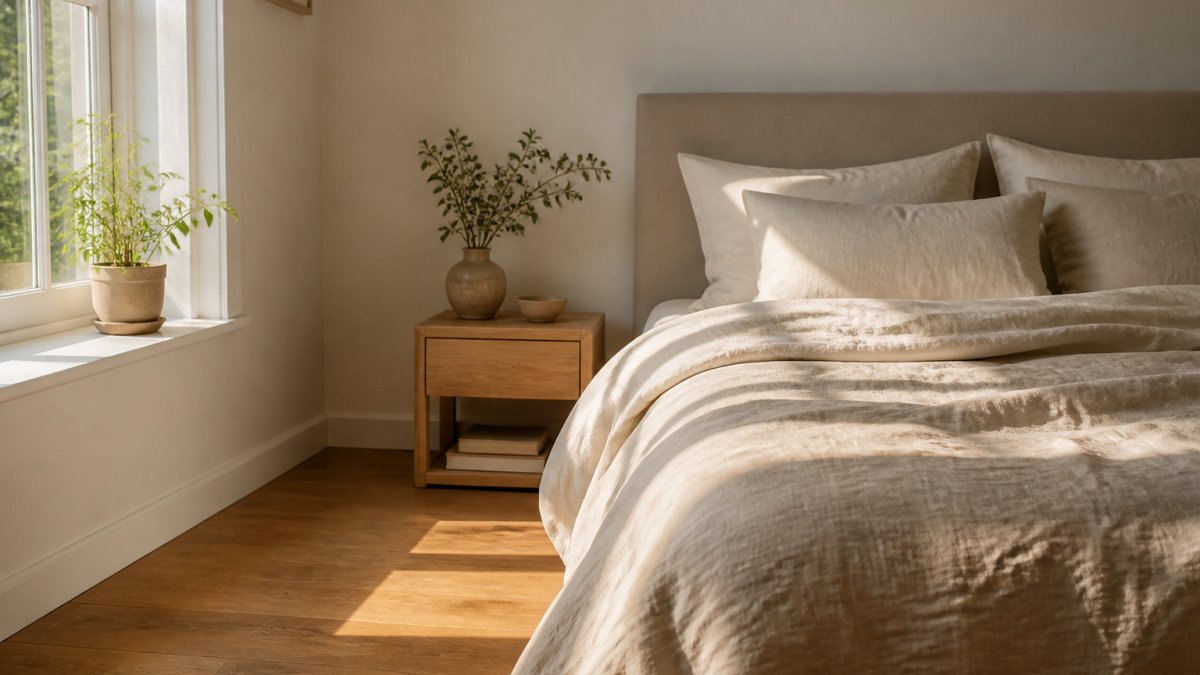
1. Light: block what wakes you, dim what winds you down
- Use blackout curtains or a fitted eye mask if early light wakes you.
- Replace a bright overhead fixture with a warm lamp on a dimmer for the hour before bed.
- Keep a small nightlight with a warm, low-lumen bulb for nighttime trips instead of turning on an overhead light.
2. Sound: reduce what you can, mask what you cannot
- A rug and a fabric headboard absorb some reflected sound.
- A white-noise machine or a fan can mask intermittent noise from neighbors or traffic.
- If you share a room, choose masking sound over earplugs so you can still hear alarms.
3. Temperature and air
- Most people sleep better in a cooler room; a fan or a cracked window can help without changing the thermostat for the whole home.
- Breathable cotton or linen bedding feels cooler than heavy synthetics.
4. Visual order and one calming anchor
- Clear the nightstand to what you use nightly: lamp, water, one book.
- Remove anything from the room that is not used for sleep or getting ready.
- Add one object you associate with calm, a candle, a photo, a stone, and place it where you see it last at night.
Accessibility and sensory notes
- If you are sensitive to texture, choose bedding you have felt in person or that has a generous return policy.
- If mobility is limited, keep the path from bed to bathroom clear and lit at floor level.
- If you are neurodivergent, reduce visible labels, cords, and patterns that compete for attention.
For a simple scent option, try the Believe in Yourself Amber jar soy candle at $21.99. It has a 100% natural soy wax blend and a 100% cotton wick, and it comes in 6 scents, including an unscented option. Keep candles away from curtains and always burn them with an adult present nearby.
Calming Home Decor Ideas for Renters and Small Budgets
You do not need a renovation to make your home feel restful. Renters and people on tight budgets can make big changes with small, removable steps.
- Swap harsh overhead bulbs for warm lamps
- Hang one piece of meaningful art on a wall
- Use throw blankets and cushions to add softness
- Rearrange furniture to open walkways
If you want wall art without holes, the Believe in Yourself Framed poster at $29.99 is a simple option. It has a matte black wood frame, an acrylic front protector and hanging hardware included. Place the mounting hooks 1 inch (2.5 cm) from the frame corners when hanging a horizontal frame.
Testing Whether Your Changes Help Your Mood
Changes only matter if they help you feel better. Track your mood for two weeks before and after one change.
- Rate your mood each evening from 1 to 10
- Note how well you slept
- Write down one moment where the room felt calm
Tracking progress over time is easier with a simple system. Our guide to best tools for tracking personal growth progress covers options you can use. Our guide to best tools for tracking personal growth progress covers options you can use.
Choosing Your First Mindful Change This Week
Pick one change you can finish in a week. Good first choices include clearing your nightstand, opening your curtains each morning or adding one plant.
Small, finished changes build momentum. Soul Perfect offers a free community for encouragement and personal growth, where you can share progress and get support as you build a calmer home.
Frequently Asked Questions
How can home decor support mental wellness?
Home decor influences how a space feels, and how a space feels can shape daily stress and mood. Researchers have begun testing whether the visual shapes around us affect how we feel, so treat design as a starting point for inquiry rather than proof. In practice, the most useful changes are the ones that reduce visual noise, add natural light, and make rooms easier to rest in. Start with one room you use daily and notice how you feel there before and after each change.
What colors can make a room feel more relaxing?
Many people find softer, muted tones such as warm neutrals, sage greens and soft blues more restful than high-contrast or very bright colors. Color preference is personal, so test a sample before committing. Paint a small patch on a wall or use removable peel-and-stick swatches and observe the room at morning, afternoon and evening. Pairing calm colors with natural textures like cotton, linen and wood tends to reinforce the effect.
How can I make my home feel less cluttered and stressful?
Begin with surfaces you see most often, such as kitchen counters, entryways and the nightstand. Remove items that have no clear purpose, then assign every remaining object a home. Work in short sessions of 15 to 20 minutes so the process stays manageable. Keep a single donation box nearby, and place only meaningful objects, such as a favorite framed print or a candle from Soul Perfect's collection, on display to avoid visual overload.
